Compassion is available in abundant supply at all times- even when our hair is on fire, our cat just coughed up a hairball on the dining room table during a family gathering, and our car needs new tires, a battery, and we can barely afford to put two gallons of gas in the tank. I think the key to freely offering abundant compassion to ourself and others is not that we lack compassion; rather this experience of lack is due to the fact that we have locked away our compassion from the disowned seeds in our mind’s garden.
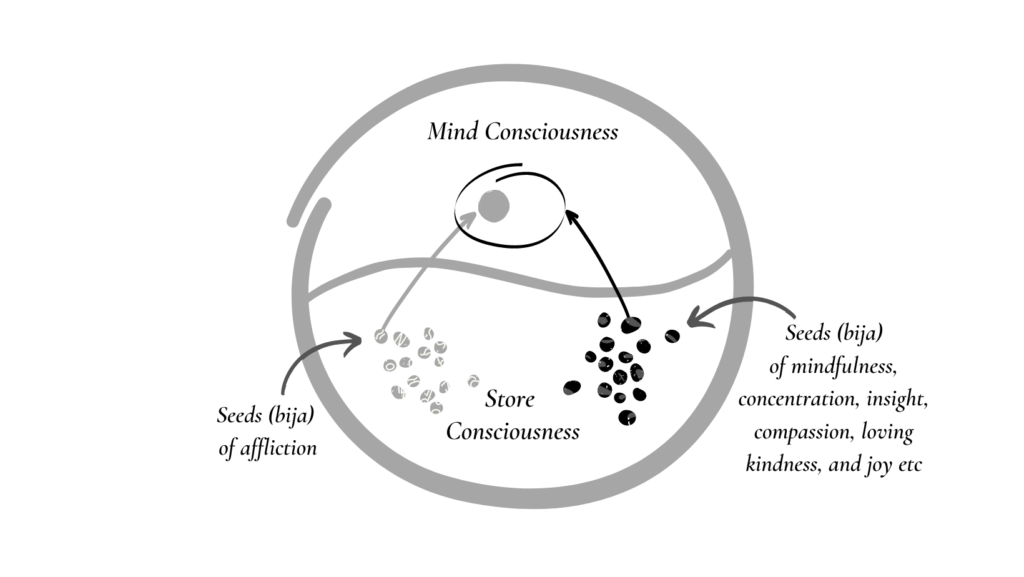
Many of us have heard of the Buddhist psychological model. We all have seeds within our store consciousness both positive seeds and more problematic seeds. The store consciousness has seeds of anger, seeds of compassion, seeds of jealousy, seeds of laziness, and seeds of love, in fact, there are seeds of every sort. Our practice is to water the “positive” seeds so they can take root and ultimately bloom into our Mind Consciousness while we allow the more challenging seeds to go unwatered and stay dormant.
If a seed of affliction in us was been watered and taken root, we know we can’t just ignore it and hope it goes away. That is like a farmer whose field has a weed take root who chooses to ignore the weed rather than address it while it is young and small. Soon the farmer realizes that one small weed has grown and spread so dramatically that his intended crop cannot grow. The Mindful Gardener will seek out the weeds and look deeply at the best way to care for the weed so that it can return to the earth and not grow and multiply
We are reminded in our understanding of the final training of the Five Mindfulness Trainings that if we consume unhealthy foods, imagines, sounds, websites, or the like…this unmindful consumption can wake up and water our seeds of affliction. The same is true for our untreated trauma experiences, lack of appropriate self-care, and addictive behaviors we may use to avoid practicing with the pains of life.
Some of the most problematic consumptions that feed or mind’s weeds are clinging tightly to belief systems that are disconnected from our own insights. Who among us can say that at least of a part of us doesn’t cling to the belief of an independent self, or who can claim that they don’t struggle with impermanence? These clinging beliefs don’t make us “bad,” they simply make us human.
In order to properly care for all the seeds in Store and Mind Consciousness, we must be our own Mindful Gardener. A Mindful Gardener doesn’t just water their flowers, a Mindful Gardener tends to the entire ecosystem that supports their flowers.
As I I have looked at this I have found a model very similar, but also integrated with some other Western psychological elements. I have found this model very helpful for me to move through the pain and suffering of my life while generating compassion and love at the same time. At the same time, this model, which I will call the Sangha of Self Model or simply the Inner Sangha has helped me understand my independent self as a construct of my mind, not an actual independent entity.
I would like to share this model and practice with you to help us generate more compassion, joy, and love in our lives. The Self Sangha has a variety of roots, Psychosynthesis as described by Roberto Assigioli, Hal and Sidra Stone’s Voice Dialogue Insights, Stanislav Grof’s writings on COEXs, Buddhist Teachings, including, but not limited to The Heart Sutra, The Diamond Sutra, The Four Nobel Truths, The Eightfold Path, the teachings of Thich Nhat Hanh, and the teachings of Larry Ward and Peggy Rowe Ward, and finally my own experiences and insights.
Let’s talk about intention for a bit. Our intention is exploring using the Inner Sangha is not about self improvement nor self actualization. Both of these intentions have inherent beliefs that there is a self that needs to be improved or a self that needs to be actualized.
Rather, our exploration has at its center the intention of understanding there is no independent self.
You have probably have heard nearly the same words in other portions of Buddhist practice. We will be learning and sharing new tools to move toward an acceptance of who we are. Some of you may ask, “So what is the intention of acceptance of who we are?” My response has two pillars – one from the Buddha – grasping at an independent self is at the root of our suffering. The second pillar is from psychosynthesis, “Everything I identify with – controls me… Everything I disidentify from becomes available to help me.”
When we disidentify from our model of an independent self we make available the energies we have locked up in our false sense of self. These energies now become available for us to direct into compassion, love, and joy. We do not need to generate more compassion, we simply need to set it free
We don’t need to become a more loving person, we just need to be brave enough to let it out of the cages we have created to contain it. We do not need to do more things to make us happy so we can feel joy…we simply need to stop our habit energies that bind our joy and make it dependent on outer events and simply release the joy that is available in every moment- whether the moment is sweet or bitter.
Seeds, Subpersonalities, COEX’s, and voices all orbit around similar concepts and each provides a slightly different way of looking at Self
when we have a strong reaction to another person or object, it is a great time to look at the subpersonality being Energized
The inner world of subpersonalities is a huge interactive, interpenetrating, Interbeing system at the level of the ego – being protected by our subpersonality known as the Protector Controller.
The role of manas in the Protector Controller The Seat of Ego In the Mahayana tradition.
The Ego-Maker (kliṣṭamanas): Often translated as “defiled mental consciousness,” manas is the function of the mind that constantly grasps onto the idea of a separate, permanent “self” or ego. Continuous Grasping: It is in a state of continuous delusion. It takes the experiences from the lower consciousnesses, clings to them, and discriminates between “me” and “not-me”.
Because it is tied to self-preservation and pride, manas acts as the primary psychological barrier to realizing the Buddhist truth of anatman (non-self) and emptiness.
Until we learn to love and work with our Protector/Controller subpersonality, much of our efforts to grow will be sabotaged
The root of the word meditation is “to remember”
The practice of working with subpersonalities, includes: Finding their name and Gender; what role they play in maintaining our ego-level consciousness; what do they look like what does it feel like when they inhabit our awareness; what do they need; what is their greatest fear?
Everything I identify with controls me; everything I disidentify from becomes a tool I can use for my own benefit and the benefit of others.
Buddhist practice is NOT about self improvement – we do not seek how to make ourself more loveable to another…rather our role is to find something to love in another as they are.
Buddhist practice is about self awareness and understanding and integration.
Subpersonalities may pass from generation to generation, so some of your subpersonalities may have been constellated prior to your physical birth.
Subpersonalities are constantly changing and developing due to both external and internal factors; therefore it is practically impossible to say I understand this subpersonality therefore, I can leave this one be and focus my practice on another subpersonality.
When we learn to see, understand, accept, and ultimately integrate a subpersonality, huge amounts of physical, mental, and psychic energies are freed up which were previously used to maintain the subpersonality.
Dreams are wonderful doorways to working with subpersonalities.
Subpersonality practice calls us to take risks and allow our courage to arise.
Subpersonality practice is best done in Sangha where we can experience, first hand, when our subpersonalities get energized and practice with them to find our own truth.
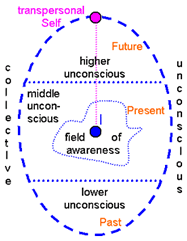
Subpersonality practice is typically done at the level of the personal self or ego so that we can free up the energy to tap into our higher Self…
Egg shaped diagram below:
Hell Realm – Intense suffering, rage, and torment includes Hungry Ghosts, instinct, ignorance, survivalDesire Realm (Kamadhatu): Beings in this realm are governed by physical and sensory desires (lust, hunger, anger). This includes the lower realms, the human realm, and the lowest heavenly realms.
Form Realm (Rupadhatu): Beings here have subtle, luminous physical bodies and are free from base desires but are still attached to form and intellect. These are the realms of higher meditative states (jhanas).
Formless Realm (Arupadhatu): Beings here have no physical form or location. They exist purely as a state of consciousness, such as infinite space or infinite nothingness, attained through advanced meditation.